 Tell us a little about yourself apart from your role as a podcast host?
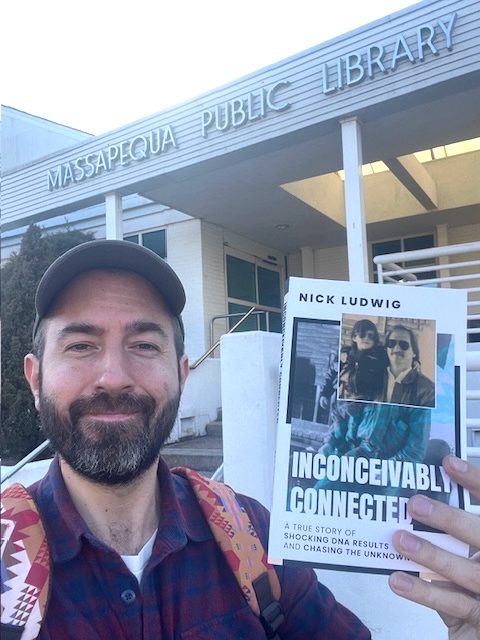
I’m just going to rattle some things off because there’s a lot! I’m a big music nerd (Spoon is my favorite band) and have DJ’d at a number of nightclubs in Brooklyn, NY. I’m a diehard New York Knicks fan and love playing basketball. I prioritize traveling off the beaten path when I’m fortunate enough to do so and most recently spent a month exploring the Amazon Jungle and Sacred Valley of Peru. Thai and Mexican food are my favorites. I wrote a book about my DCP (donor conceived person) discovery called Inconceivably Connected: A True Story of Shocking DNA Results and Chasing the Unknown. I’ve worked in restaurant technology sales for about 12 years and once built a mobile app for users to redeem complimentary appetizers at restaurants all over New York City. My wife, Ana, and I live near my hometown in Long Island, New York. I’ll leave it at that for now!
When did you learn you were donor conceived? What were the circumstances and how did it affect you?
I found out the day after I turned 36 years old … and it was the shock of my life. My younger siblings bought me a 23andMe kit for my birthday, and once my parents were informed this was my gift, they sat me down to let me know there’d be a chance for surprising results if I took the test. Receiving this information changed nothing and everything at the same time. My first thoughts were focused on my parents and how they must’ve felt to have harbored this truth for my entire life. In a way, I found myself parenting my parents in the earliest moments because I could see how fearful they were that this big reveal could somehow break our bond. The reality is we’re closer than ever now. But in the moment, after I assured my love for them, things became quite blurry. I remember replaying all of my life and slowly began to realize how this news could actually make some sense. I don’t feel too out of place in my family, but there are enough differences between me, my dad, and my paternal extended family that things began to click a bit more. I now had explanations for why I’m a little bit different, and I was okay with that. I remember saying, “This is kind of cool, actually… regardless of the results, I get to dig deeper into who I am now.” At the time I said that, I don’t think I’d considered some of the heavier emotions that would come with this entire process … but the point remains true. For some reason, I seem to be attracted to the unknown.
Did you search for biological family after that discovery, and if so, what was that experience like?
I very quickly became aware of connections to 13 new half-siblings (and counting, potentially). I also quickly received an email from a half-sister showing correspondence between the donor and another one of my new half-sisters, where some key family and medical information was shared by the donor. Beyond that, there’s been no communication between the donor and any of us. After several weeks of letting the dust settle from my discovery, I began meeting up with a few of the half-siblings who were open to it. The experience was as trippy as it gets – catching flashes of my own face in the face of others who were essentially strangers, seeing the similarities in mannerisms, interests, and personalities. It’s been a wild ride but one that I immediately knew I wanted to experience in full. The more I know of these people, the more I can understand myself. About half of our group continues to touch base periodically, with a few of us making time to meet up every now and then.
How do you describe your podcast?
Simply put, it’s a storytelling podcast for donor-conceived people. There are no rules or guidelines for guests other than to openly express as much or as little of their lived experience as they feel comfortable with. As the host, I’m there to ask the appropriate questions and prompt further contemplation, but other than that, my mantra is “the less I speak, the better.”
How did the podcast come about? What was the inspiration?
I put my book out in February 2025, a few months before launching the podcast. Amidst some of the confusion experienced upon the truth coming out and trying to make sense of it all, all I really knew to do was to write in my journal about all the unusual feelings and emotions that were coming up. It was never my intention to write a book, but at a certain point, I realized I had enough content to actually piece one together. The writing and publishing process was so therapeutic for me that I began to wonder how I could extend that feeling to others. Then I realized a podcast could offer an outlet for people to openly express their own versions of the DCP experience, and thus, the podcast was born. I had no idea what I was actually doing (sometimes I still don’t!) and am especially grateful to the earlier guests who put their trust in me without having any idea what the final product would look like.
Can you describe one or two of your favorite episodes?
I really don’t like choosing favorites when it comes to the highly personal and sensitive stories I’m privileged to hear. I know that’s not the answer you’re looking for, but the truth is they’re all my favorites. I’m so proud of every guest who steps up to the plate to put the truth out into the open, and it’s the expressions of fearless honesty that I specifically set out to capture when I decided to launch the podcast. Every single guest has answered that call. I will say, so far there is only one episode that has brought me to tears (I can be a tough nut to crack) … but I’ll let you try to figure out which one it was!
What’s your goal with the podcast? What do you want listeners to come away with?
I want guests to feel empowered by sharing their stories. I want to create a safe space where donor-conceived people have a chance to take control back of the narrative; to clear the air; to continue to process their emotions in a way that feels healthy. I want anyone who listens to understand that the truth does, indeed, set us free. And perhaps most importantly, I want this community to serve as an example of how to cultivate empathy, because too many of the world’s problems seem to stem from a lack of it.
What’s been the reaction so far?
You know, before I started the podcast I put posts up on Reddit and Facebook to see if anyone was willing to share their story on a totally unknown and new platform like this. I was expecting maybe 2 or 3 responses. But within 24 hours, I had over 30 people who filled out the detailed guest form I created. It was at that moment I knew creating this podcast wasn’t a choice anymore—it felt like it was now my responsibility. Long Island’s Newsday eventually caught on to what I was doing and did a feature story on the podcast as well as the experiences of several other members of our community in the New York area. The podcast audience continues to steadily grow and has listeners in over 100 different countries. In a strange way, it feels like I’ve randomly stumbled into my life’s most important work.
What if anything has surprised you in the course of doing the podcast or that you’ve heard from a guest?
The infinite range of the donor-conceived experience is what continues to boggle my mind. For some people, it’s identity shattering. For others, it makes everything make sense. It can tear families apart or it can make families stronger. It can spark creativity and open new doors or it can create endless confusion and keep us from moving forward. Some become fully transparent, others lean deeper into denial. The point I’m getting at is I never, ever know what to expect from each story, and I think that’s what makes this subject matter so compelling. I often find myself asking what are the key factors that contribute to how DCPs respond to late-discovery? I have an idea of what those answers are for me, but they could be completely different for someone else. It’s my hope that as the podcast’s collection of stories grows larger, we can begin to more confidently point to the triggers that connect to certain types of outcomes.
As you listen to your guests, what feelings or concerns are most commonly expressed?
I’ll start with the positive because it’s the most consistent: discovering and getting to know new half-siblings is almost always the biggest reward that’s expressed. I often ask what’s been the greatest positive of the donor conceived experience and it’s almost always the new connections to half-siblings that gets mentioned. And I echo that myself. Those we are connected to by DNA give us a fuller context into who we are ourselves, and context is everything.
On the end of what’s most challenging, it’s often more complex. DCP almost universally feel deprived of a basic human right to know where we come from. Many of us don’t have an accurate medical history. There’s fear of accidental incest. There’s plenty more to mention here, too. The concerns still far outweigh the rewards, which is all the more reason why DCP voices need to continue raising the volume on our experiences. Change is unlikely to occur unless the boat gets rocked a little bit!
Tell us about your book, Inconceivable Connected: A True Story of Shocking DNA Results and Chasing the Unknown?
The book was my attempt to draw connections between the most “unknown” or “taboo” elements of my life experiences and how approaching them all with an open heart and open mind can lead us to deeper wisdom and understanding. After genuinely having my mind blown by my donor-conceived discovery, I found myself feeling like I was standing back on mostly solid ground rather quickly … and the book had me examining why that might be. Part 1 lays out my discovery itself and some of my insights around it. Part 2 takes the reader into the minds of the people most closely involved in my story by way of transcribed interviews. And Part 3, despite perhaps “going off the deep end” a bit, illuminates areas of my life that are linked by the choice to confidently approach the unknown rather than shy away from it.
Why did you feel the need to write it?
I felt like I needed to reintroduce myself; to say out loud who I really am, after all. But I also needed a written record of the ultimate plot-twist to my life; it was all just too crazy to not have it fully documented. I was also looking out for the future 70-year-old version of myself who would want to remember what this period of time in my life was like. And I had this deep urge to conduct a thorough analysis of how we could possibly have gotten to this point where, at 36-years-old, I’m all of a sudden not biologically linked to my dad. I love that it’s become part of my story now, but it’s still beyond my full comprehension in some ways. But ultimately, and most importantly, I knew writing and releasing the book had the power to heal. Not just me, but my whole family.
Why do you think it’s important for people to share their stories?
The older I get, the more I realize lived experience is our greatest teacher. All the certifications, the academic studies, the readings … that’s all great. But there’s no replacement for lived experience. For late-discovery donor-conceived people especially, we have a lived experience that is highly unique … and when it comes to stories, it’s the highly unique ones that people tend to give their attention to. So, if we’re able to garner peoples’ attention … and we have the unique lived experiences, then we have a chance to be teachers. Donor-conceived people are an empathetic group, and as I mentioned before, it’s my belief that a little bit of empathy can cure many of the world’s problems. So, why wouldn’t we aim to share that? Why wouldn’t we put more of that out into the world? Storytelling isn’t just important to me—it’s bigger than that. I believe it’s my duty to share my story as an evolving human being.
How important do you think community is for donor-conceived people and what purpose does it serve?
It’s absolutely vital. The DCP experience can be tremendously isolating and lonely at times, and I don’t think we should ever underestimate the power of connecting with others who can understand it firsthand. After attending the Untangling Our Roots Conference in Atlanta earlier this year, I was able to fully realize how valuable it can be to be amongst those who can personally relate to what we all go through. No one—NO ONE— is alone in this experience. And if for anyone looking to come together with others in our community, the first Inconceivably Connected Summer Retreat will take place in Bethel, New York from August 28-31st. More information can be found here—we’d love to see you there!
Are you looking for participants and if so, how should they contact you?
Always! Anyone interested in being a guest can fill out this form, and I’ll do my best to be in touch with them ASAP!
Any closing thoughts?
I think it’s important to note that none of what you just read about my experience had ever been on my radar prior to three years ago. In 2023, I would’ve laughed at anyone who suggested I had it in me to write a book. I would’ve rejected the notion that I could host and produce an internationally-reaching podcast. I would’ve said I’m not the person equipped to lead any sort of community gatherings.
So, do I think I was predestined to be in the position I’m in now? I’m not sure I’d go that far. But I do think life has a funny way of opening up certain lanes for us to venture down. And when I notice the signals that a new path is forming, you can bet I’ll be choosing to explore what potentially awaits me. The possibilities are too enticing. The potential reward is too valuable. This is how I grow, and I’m lucky enough to share it now.