By Roberta Holland
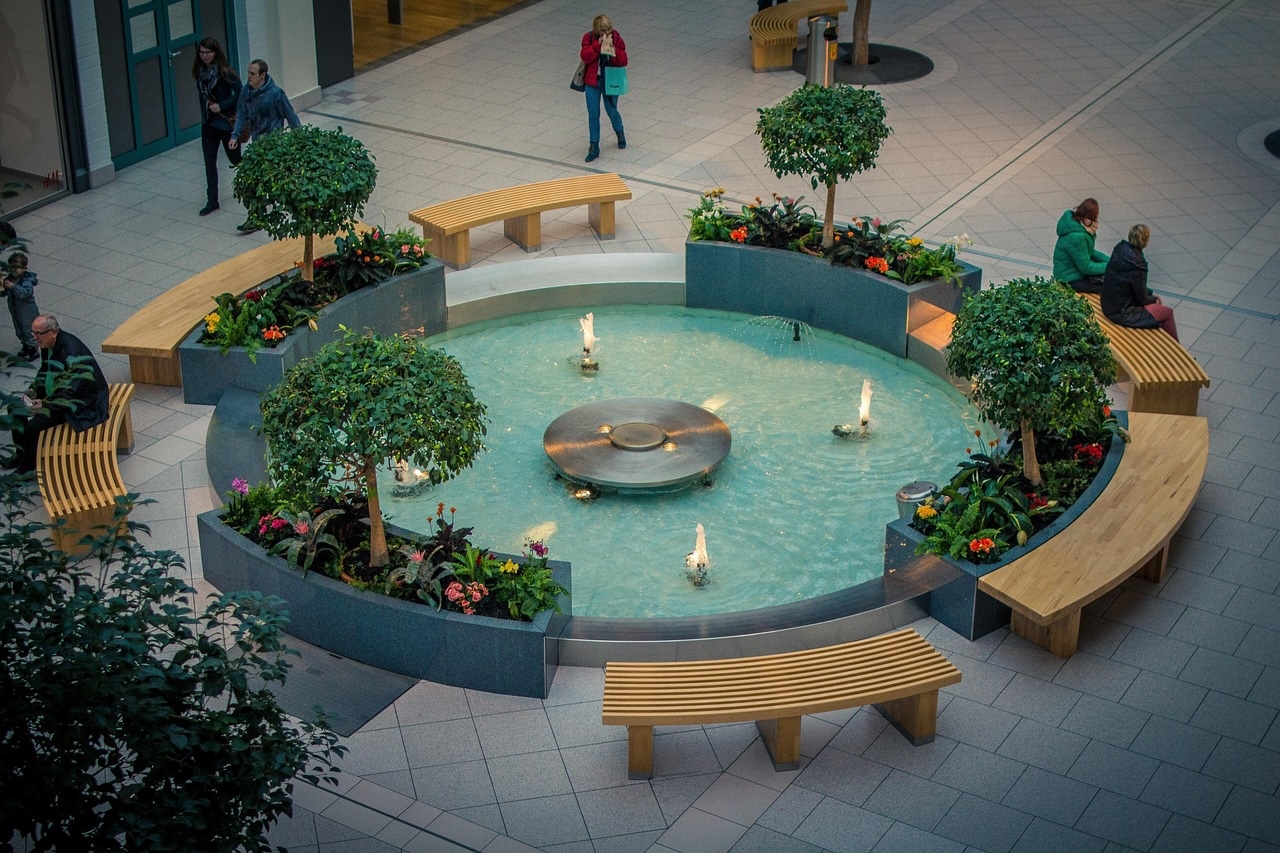
The glitzy mall I picked for our meeting spot hadn’t aged well in the 20 years since my last visit. Marble floors no longer teemed with shoppers. The life-like bronze sculpture my friends and I had nicknamed Jeremy looked lonely next to the burbling fountain. High-end boutiques had been replaced by a Department of Motor Vehicles on the ground floor. But it still boasted an underground parking garage, key in the heart of Georgetown.
It would be different in person. That’s what I told myself as I tugged down the hem of my blouse and looked around the near-deserted mall. The bored security guards eyed me with moderate interest as my saliva dried up with each ding of the elevator.
I was waiting for my mother, had been waiting for her for 42 years since the day she signed away any claim to me. She had been waiting for this specific moment for two years, and wasn’t happy about the delay.
Delay caused by cascading dominoes: ailing and then dying adoptive parents; the day to day needs of my small children; deadlines for my freelance work; all of which made it tough to fly 500 miles to meet her. The occasional slurring of her words on the phone made me hesitate to invite her to visit me instead. Boundaries; a new concept for me. Madeleine vacillated from patient and understanding to frustrated and angry.
“Why do you want to meet this person,” my friend Lori asked when I was planning my trip. Lori, raised by her biological family, had heard the ups and downs since the adoption agency first put me and Madeleine in touch.
How to explain this most basic need, to breathe the same air as the woman who grew my lungs? I mumbled something about needing to meet her in person, even just once, despite the red flags. But in truth I felt a pulsing, bone-deep desire to connect. To ask the questions simmering for more than four decades.
Asking questions was in my wheelhouse. Trained as a newspaper reporter, I was good at peppering politicians, entrepreneurs, and the random man on the street for their thoughts, digging into their life stories. The irony not lost on me that I couldn’t dig into my own story. Not until the court order and the agency agreed, that is.
Any reporter knows you get more out of a subject in person, physical proximity helping you forge a connection, even if only fleeting. That’s what I was banking on with Madeleine, why my heart accelerated every few minutes only to see an empty elevator car.
I felt certain I would recognize her even though none of the photos she shared were recent. She described leaving her poor Alabama roots behind, her current love of the finer things, words conjuring images of pearl chokers and diamond tennis bracelets.
Ding.
Madeleine stepped out, looking more like my middle-schooler than my mother: dark leggings, woolen socks, clogs, a fuzzy sweater stretched tight over her belly. In my jeans, blouse, and flats I somehow felt older. Slightly thinning, faded red hair was the only tell of her 63 years.
We hugged awkwardly, her enormous sunglasses poking into my skull, before making our way to the Starbucks across the street. I eyed the laptop warriors dotting the tables around us. Were they listening to our stilted conversation? Wondering why two women with identical snub noses and similar hair, slightly different shades of red, acted like strangers?
My body felt no zing of instant connection, no double helix weaving us together again as I clutched my coffee mug. Madeleine, too, seemed unaffected to be meeting the baby she gave away. The baby she may or may not have ever held, depending on which version of the story she offered up in the moment.
To fill the silence, I slipped into reporter mode. I lobbed a softball question. She delivered a 20-minute monologue. Repeat as needed.
“So, you came from a big family?”
Insert one long run-on sentence that included names of a half-dozen siblings, their spouses and offspring, then segued into her parents, a logging accident, an anecdote about foot rubs, and an estate battle over the family land.
Zero questions from her about me, my family, my kids. Madeleine knew the basics from the phone calls and emails leading up to our meeting. The basics seemed enough for her.
Madeleine also knew our reunion coincided with another one – my 25th high school reunion that brought me back to D.C. for the weekend. But she asked no questions about it. Not where I was staying or how long I was in town. Not even what high school I had attended. Had she asked, I could’ve shown her. We were only blocks from the brick-walled campus; just a couple miles from where she gave birth to me.
“I brought you some pictures,” I said during a lull. I tentatively handed her a small photo album of the greatest hits of my life – first communion, graduations, wedding, babies – painstakingly curated so not even a shadow of my adoptive family appeared in any of them, edited to protect her from pain or maybe jealousy.
“Oh,” she said, stuffing the album, unopened, into her ginormous purse. “I didn’t get you anything.”
When she invited me to lunch at a posh Italian restaurant the following day, I agreed half-heartedly. Maybe I put too much pressure on our initial reunion. Maybe the awkwardness would wane and now we could connect.
“Do you have a reservation,” the maitre’d asked, skirting a glance over my jeans and Madeleine’s stretch pants and no doubt noticing the small oxygen tank Madeleine toted that day.
“No, but I think you can fit us in,” I told him, glancing at the almost empty restaurant tucked below street level.
Sighing, he squeezed us into a small table partially hidden by a column. I unfolded an expertly pressed cloth napkin and placed it on my lap, waiting. Madeleine had decided to ask me questions that day.
“Do yewww like bacon?” the words dripping with her thick drawl.
I stared at her across the table, the giant sunglasses hiding her eyes even though the restaurant was so dark I could barely read the menu. Did she really just ask me about bacon? Do I even have a stance on bacon?
“I guess.”
I excused myself to go to the ladies’ room and darted up from the linen-draped table, something I did so often during our lunch that she probably thought I had a kidney infection. Pacing in the restroom, I wondered what Forrest Gump-like recitation of bacon dishes I had just escaped. Bacon cheeseburgers, bacon and eggs, bacon-wrapped scallops…
Back at the table I watched in awe as Madeleine cut into her fettuccine alfredo then stuck the table knife deep into her gullett like a sword-swallower, licking the creamy sauce from the blade. I pictured my adoptive mom watching this scene from the great beyond, and laughing her ass off.
I glanced at another table, a group of Talbots-clad ladies probably the same age as Madeleine. Their preppy clothing and hushed laughter seemed so much more familiar. Why did I feel more connected to those strangers than the one sitting across from me? Than the one who actually looked like me?
“I noticed in the picture of you with your kids,” Madeleine started.
I straightened. Would she tell me that my daughter had her aunt’s eyes? That my son had his grandpa’s lanky build? Mention some family resemblance connecting us all?
“…there was a wine rack in the background. Do you and your husband drink a lot of wine?”
I deflated.
“Not really,” I said. “People give us bottles, but we mostly drink them on holidays.”
I made a mental note of her asking about alcohol, remembering the ever-present tinkling of ice cubes during our phone calls. And I remembered the empty Yellowtail bottles I would find hidden in my adoptive mother’s kitchen cabinet.
“I feel like you’re putting a wall up again,” Madeleine said, the expression in her eyes unreadable behind those sunglasses.
An uncomfortable pause as I tried to come up with an honest reply.
“I think it’s because of the letter you sent me,” I said, coiling the cloth napkin in my lap tighter and tighter.
“Letter?” Madeleine drawled, slurping fettuccine off her fork.
“Yeah, the letter you wrote me saying I just found you to toy with you, and that you didn’t want anything more to do with me,” I said. “It was about seven pages long, handwritten in loopy cursive.”
Madeleine kept eating. No quick denial. No slumping in the plush, high-backed chair. Not even a beat-long pause as she processed my words.
“Well, I don’t remember writing any letter, but that sounds like me,” Madeleine said with a slight shrug of the shoulders.
This letter had gutted me. A fresh rejection from the mother who had walked away from me once before.
“And you addressed it to Alberta, not Ro-berta,” I continued, the subtext crystal clear in my mind. If you’ve been pining away for the daughter you gave up for adoption, and she finally finds you, you should remember her new name.
“Well, I guess that’s because I thought you look like an Alberta,” Madeleine said.
I wasn’t expecting her to fall to her arthritic knees on the carpeted restaurant floor, clutching the faux plaster column, and beg my forgiveness. But at a minimum a “my bad” was called for here. Instead she doubled down, adding what felt like an insult – although I really didn’t know what an Alberta was supposed to look like.
The frustration fueling her letter was easy to understand. I knew the delay in meeting was hard on her. But it wasn’t just my hectic life that prevented me from jumping on a plane. It was the way she seemed to think I was her answer to everything. She had told me that she started smoking after she gave me up, suffered with COPD for years, and now she could finally quit. And that family rift festering for decades? Her sisters would be so happy for her that I was back, they would set aside the old grievances and welcome her back into the fold. Welcome her.
In the years-long run-up to our meeting, Madeleine casually dropped nuggets of information like radioactive breadcrumbs. Her parents had pledged to support her if she wanted to keep me. One of her sisters offered to raise me as her own. She dated two other men while pregnant with me; married one of them a month after my birth. She insisted she made the right choice, even after I shared the broad strokes of the physical and sexual abuse permeating my childhood. She couldn’t let go of the fairy tale that I was “better off.”
I didn’t know how we would ever connect if she refused to see my truth, each question and answer wedging us further apart rather than bringing us together. So maybe honesty wasn’t called for in our reunion.
“What was that?” I had missed another question Madeleine posed.
“I asked what kind of music do you like,” Madeleine said.
Different answers tumbled through my brain like cherries and sevens on a slot machine as I felt my inner middle-schooler rise to the surface. I tried to think of the genre Madeleine would least likely appreciate. Something to prove this stranger and I had nothing in common.
“Rap.”
Maybe Madeleine had been right not to ask me any questions the day before.
Maybe bacon, wine, and music were the wrong questions.
Or maybe she knew that after four decades apart, haunted by that unspoken question, what if, there were no good answers.
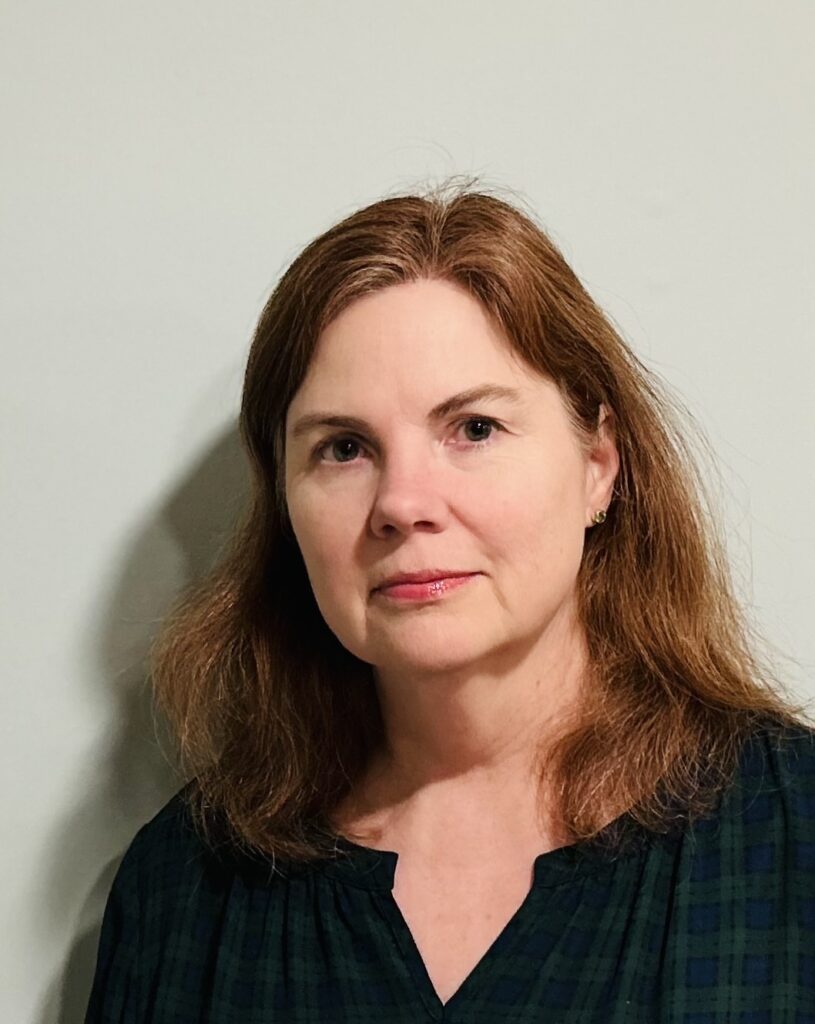
Roberta Holland is a domestic, Baby Scoop-era adoptee who found her biological parents in her 40s. After years working as a journalist and telling other people’s stories, Holland is now telling her own. She is a firm believer in the power of storytelling and a proud member of the Adoptee Voices and GrubStreet writing communities. Her work has appeared in Hippocampus, AdopteeVoices.com, Working Knowledge, Boston Business Journal, and other business and tech publications. Holland lives in Massachusetts with her husband and two children.