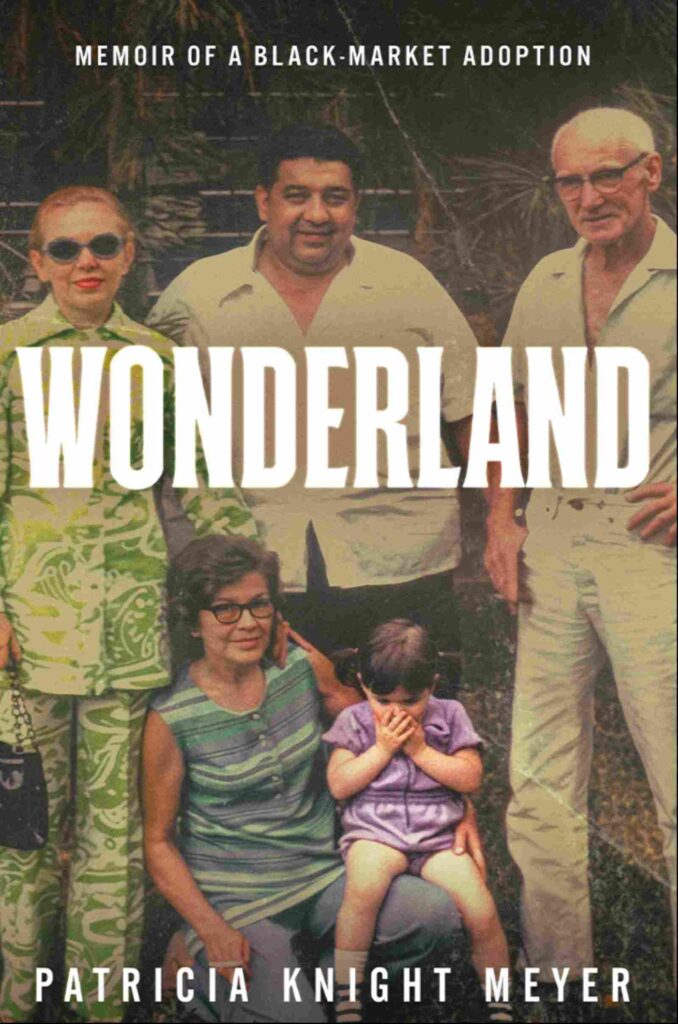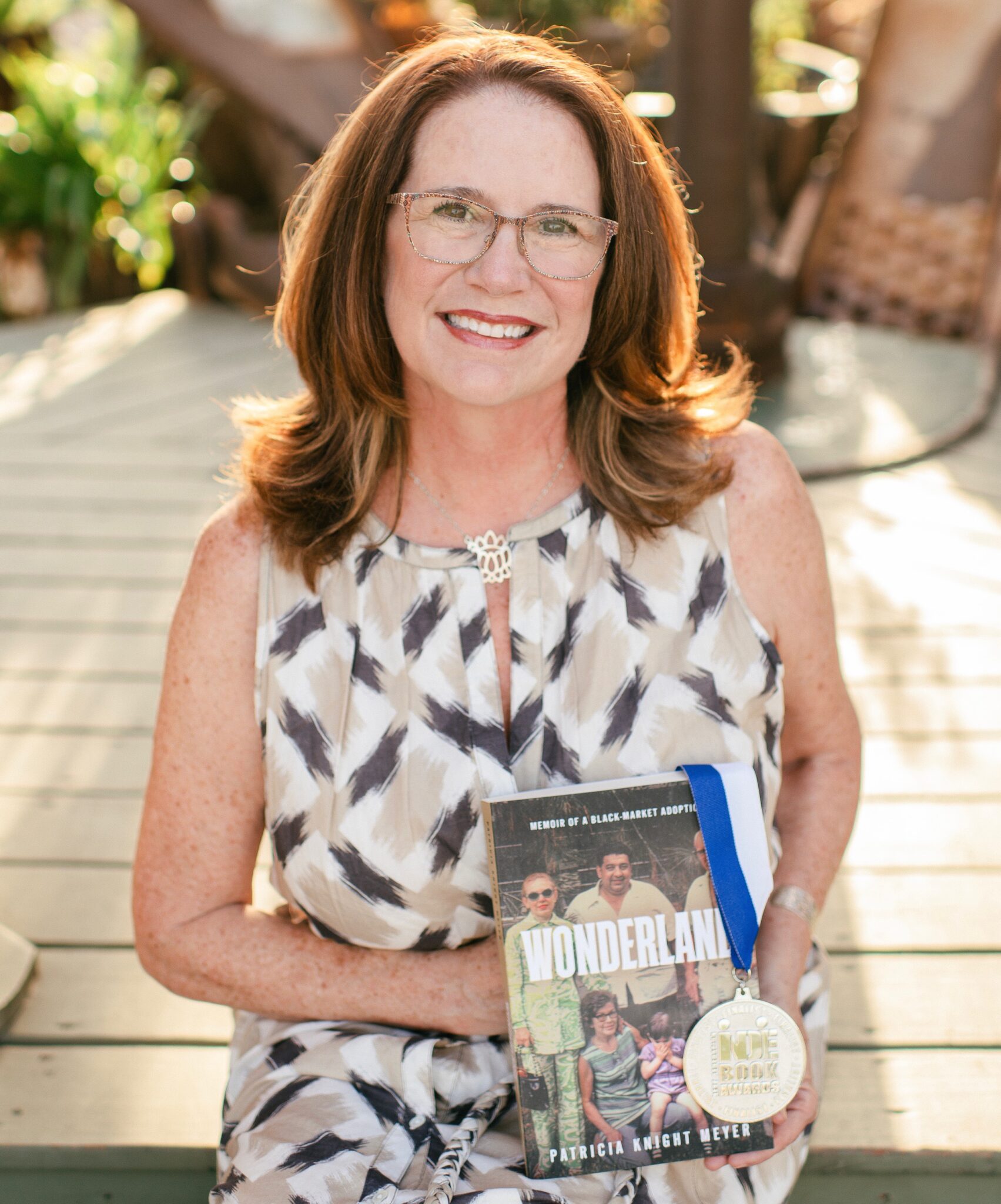
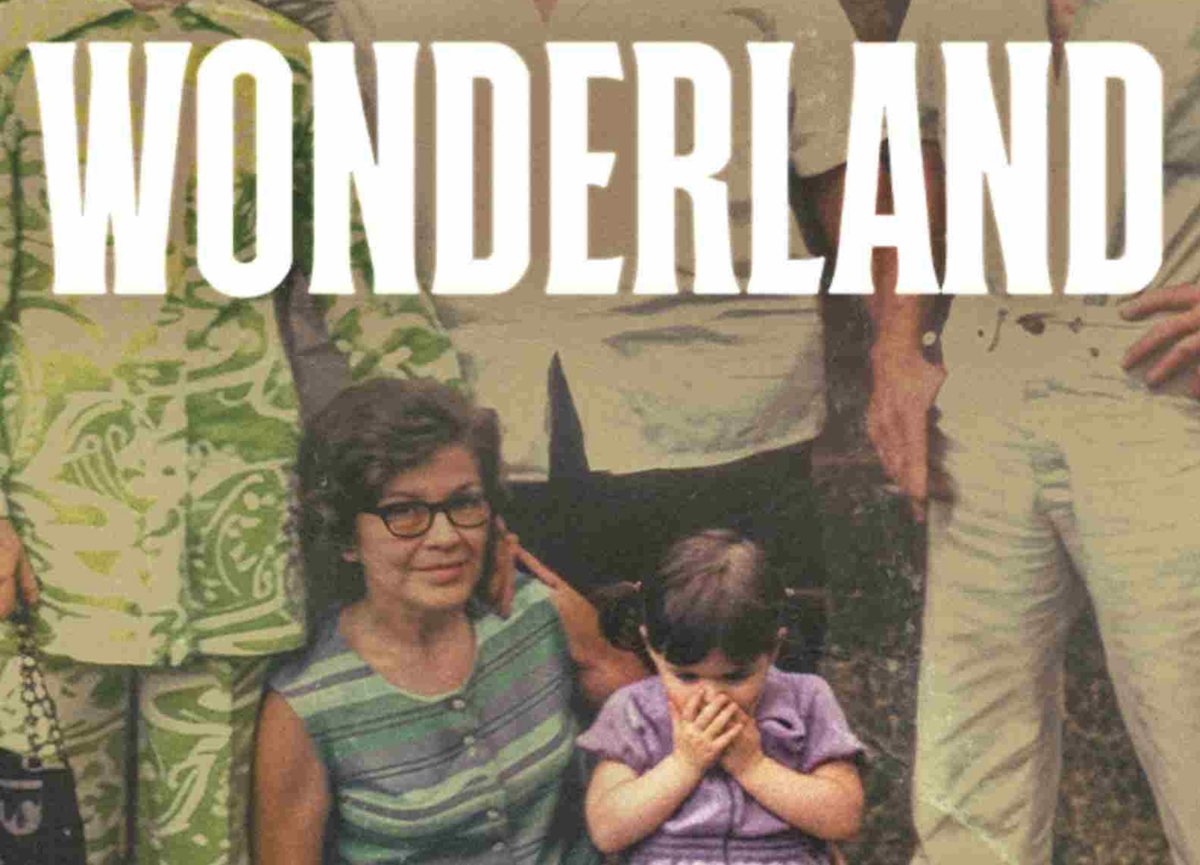
Patricia Knight Meyer is a journalist and adoption reform advocate. Hers is the story of a bartered baby who grew up to effect change and advocate for adoption reform. A University of Texas journalism graduate, she serves on the board of the National Association of Adoptees and Parents, hosts a monthly Happy Hour Zoom for NAAP and a monthly writing group for Concerned United Birth Parents, and speaks at national adoption conferences, on panels, and at adoption camps. Her essays have appeared in Ms. Magazine and Severance, and she has appeared on Al Jazeera’s The Stream, Fox 5 DC, and HuffPost Live. She runs the online community at myadoptedlife.com. WONDERLAND is her debut, published at 56, after six years of writing, two years editing, and two years pitching.
In a few sentences, what is WONDERLAND about?
I was trafficked along a Texas hospital curb in 1970, no judge, no paperwork, no questions asked. I was never legally adopted. I grew up with a made up birthday and a fraudulent birth certificate, raised by parents who were blackmailed by the same attorney they had hired to get around the system. They paid $30,000 to keep their paperless child. At 38, with no records, no known birth name, and no confirmed date or place of birth, I tracked down the attorney who trafficked me, reunited with both of my birth parents, and at 47 held a legal birth certificate with my real name on it. And I wrote a book about it. WONDERLAND exposes America’s hidden baby trade and asks: as reproductive rights erode, are we ready for Baby Scoop 2.0?
You always knew you were adopted, yet knowing and understanding are not the same. When did you start to suspect there was more to your story than you were being told?
It started when my parents confessed they’d never received my birth certificate and didn’t know my true birthday. Their revelations shook me and led me to really begin to question my origin story. Was I a stolen baby? Why would a child have no papers unless someone had something serious to hide? My identity crisis deepened when I learned the attorney had extorted my parents, threatening to “repo the baby” if they didn’t pay more. They paid double and still received no papers. At 19, I’d discover no adoption had been filed. Looking back, I understand this was how business was done then: hide every tie to the birth mother, even if it meant withholding or falsifying papers.
At twelve, you learned there was no birth certificate behind the story you had been given. How did that shape the way you saw yourself as a child?
Heritage Day in seventh grade came shortly after my parents’ confession. The assignment was simple: wear ancestral attire or your standard uniform, which for me was your typical private school green and blue plaid skirt. Not knowing my ancestry bothered me deeply. I didn’t want to wear a Scottish kilt for my mother’s side or a sombrero for my Hispanic father’s side. In my gut, I knew my outfit was supposed to represent my ancestors. Where I came from. So I went as a delivery doctor. “I came from the hospital, didn’t I?” I announced to my parents. “I can let people know about adoption!” That was as far back as my truth went.
Even as a small child I tried to figure out who I looked like. Over the years, I studied my mother’s hands, my grandmother’s hips, searching for similarities. I was a chameleon in junior high and high school, when there is so much pressure to know who you are and hold good boundaries. I was so afraid of rejection that I went along with whatever the crowd wanted and would do almost anything to be liked.
Your mother drank, and your father’s health required constant care. What role did you take on in that household?
I like to say my mother drank and my father ate, and I grew up trying to save my saviors. Ours was a codependent home, and I learned codependent ways to survive. Adoptees in general are desperate to feel deserving, and I felt I had to prove my worth and do anything to belong. Taking care of my parents ensured I would never be removed from my family. It left me with a deep need to be needed, and that need shaped many of my romantic relationships. I carried that codependence into adulthood and had to learn that need does not always equal love, and that sometimes my own needs should come first. Nobody had ever modeled healthy boundaries for me, so I didn’t know how to set them. I struggled with that for the first 30 years of my life.
Many adoptees expect reunion to close the book on their questions. What did reunion actually give you?
Many adoptees believe reunion will answer every question about their adoption. Often it only brings more unknowns, and questions that will never be answered. I was sure that finding my birth mother would give me my true birthday. Instead, it added more possible dates. She remembers December 22. The Texas birth index says January 5. I may never know for sure.
My conception raised questions too. How did my paternal grandmother, my birth father’s mother, know about my birth mother’s pregnancy? My birth mother had always believed a different man was the father. Only after I came back into her life did she remember there could have been another man, and he turned out to be my birth father. Trauma can distort and destroy the truth over time, so I don’t believe her memory is accurate. Sometimes our brains believe that the stories we tell ourselves change, fade, morph into what they need to be so we can bear them. I can understand that. I never expected that the trauma of relinquishment would leave her unable to remember the facts of my conception.
So much in reunion is unpredictable. Within three hours of my birth mother getting my email, we were meeting in a catfish restaurant parking lot.
Did you ever wonder if the truth would hurt more than not knowing? Where do you land on that now?
I have never been someone who would rather not know. The truth matters too much to me, and I never once wished I could avoid it to spare myself pain. The real pain is living your whole life without any truth about yourself or where you came from. No matter how hard the story was, I needed to know it, because without the truth your mind goes to dark places. I believe it is always better to know. I like to say that when it comes to reunion, it is not who you find, but that you find that matters most.
That said, every adoptee is different, and I never try to push another adoptee toward reunion if they don’t feel drawn to it. Some people are fine not knowing the details of their origin story. Some hold on to the belief that their birth mother wasn’t interested in reunion and gave them up willingly.
Very few birth mothers I have met have told me they did not feel coerced or pressured to relinquish. So personally, I challenge that narrative. But it is not my place to tell an adoptee whether to search for a birth parent. Reunion is HUGE, and SCARY, and RISKY, and HEAVY, and you have to really want it.
You received your first legally obtained birth certificate at 47. What was it like to finally hold that document?
When I finally got it, I think I dissociated a little. I was still very upset that my adoptive parents’ names had to be removed and separated from me to obtain it. I wanted my birth father’s name on it, and my own, but it bothered me that the people who raised me were not. I wished for a birth certificate with all four of my parents on it. So even though I needed that document, it still felt fraudulent to me. It recorded my heritage, but not my parentage. I was grateful to my birth father for helping me get it, but I don’t think I showed him enough appreciation, because every time I looked at it I wanted to cry. It never felt right, and I don’t think it ever could unless all four of them were on it.
Where do your birth parents fit in your life today, and do you feel you belong to both of your families?
My birth father passed in 2022. We had 11 wonderful years in reunion, and he healed me in ways no amount of therapy could. We were so much alike. He held a mirror up to my soul and helped me heal so much of my past trauma. I chose November 3 for the book’s release because it is the anniversary of his passing. This summer I did my audiobook listening passes sitting in the Frio River on his property. As butterflies flitted about and red birds swooped by, I felt him with me every afternoon.
I am not in reunion with my birth mother at this time. No matter which family I am with, I will always have one foot in and one foot out. My half brother through my birth father and I don’t share a history. We missed 40 years together, so we will never feel completely like we come from the same family. With my adoptive family, I am half in the room. With my biological family, I am half in the room. I always will be, and there is no undoing that.
What do you hope readers carry with them after finishing the book?
Several early reviewers’ main complaint is that I don’t include enough history of the black market. Well that is a win if you ask me! Others said they had no idea about the Baby Scoop Era and black market adoptions, and that the book sparked their interest in adoption laws. I happily take all of that as a double win.
At its core, the book is about identity, belonging, family, secrecy, truth, resilience, addiction, generational trauma, and the lifelong effects of separation from one’s mother.
And I hope readers sit with the bigger questions WONDERLAND raises. How do genetics and environment shape who we become? Can love and harm exist in the same family? Who do sealed adoption records really protect? What do we make of the expectation that adoptees should feel grateful? And how do you write an honest memoir when trauma has altered memory and the official record can’t be trusted?
Writing came long before this book. How did you get here, and when did you know this was the story to tell?
I knew by the age of ten that I wanted to be a writer. I wrote songs, short stories, poems, and plays, and at 12 I started my own junior high newspaper. As a teenager I was set on writing for Seventeen or Cosmo, which led me to a degree in magazine journalism.
Then motherhood, and caring for my mother and my daughter, pushed those dreams aside. I took the higher paying jobs, and my journalism plans turned into a career in digital tech marketing, where I wrote corporate communications and advertising and handled book publicity for other authors.
I graduated from the University of Texas journalism school and worked as publicist to an author with five published books. I always said I would write a book once I had a story to tell. After finding both of my biological parents, and discovering the attorney who trafficked me and that he had also trafficked my cousin, I knew I was ready.
I searched for my birth parents because I needed my true origin story, and because without them I had no way to get a legal birth certificate. Once I found them and the truth began to unravel, I realized this was not only my story. How many other paperless babies had this man left behind? I hope sharing my story inspires others to find their truth. I hope no one else has a story like mine, but if there are other paperless Texas “adoptees” sold by this man, I want to connect with them.
I also wanted to help adoptees in reunion avoid the mistakes I made, and to help adoptees see how adoption may have shaped the way they move through the world. I wanted to share how I came out of what many adoptees call “the adoption fog”: the denial that adoption has affected us in any significant way, and the grateful “I was chosen, I am special” story so often handed to adoptees early in life. When I began my search, I was still in the fog. I thought I’d turned out fine and was eager to show my biological family I was okay. The problem was, I wasn’t.
What began in 2011 took about six years to write, two to edit, and two to pitch. The book’s own story includes a divorce, a house fire that took everything, divine providence at a writing retreat in Costa Rica, and an unconventional road to publication.
Which books would you place on the shelf beside WONDERLAND?
NetGalley readers have compared WONDERLAND to Lisa Wingate’s Before We Were Yours, Jeannette Walls’s The Glass Castle, and Tara Westover’s Educated.
I’d also shelve it beside Mary Karr’s The Liars’ Club for its East Texas setting, frank voice, and tangled family secrets; Samuel D. Hunter’s The Whale; and Rebecca Wells’s Divine Secrets of the Ya-Ya Sisterhood for anyone drawn to complicated Southern mothers and daughters.
On adoption history, it belongs alongside Gretchen Sisson’s Relinquished, Rebecca Wellington’s Who Is a Worthy Mother?, and Jane Blasio’s Taken at Birth.
There is also an unexpected link to Lewis Carroll’s Alice’s Adventures in Wonderland. Many chapters open with a Carroll epigraph, echoing the book’s rabbit holes, hidden identities, locked doors, and disorienting search for the truth.
Beyond the pages, what else can readers explore?
The print edition includes discussion questions and recommended reading. The book’s website offers more: a photo gallery, an Easter Egg audio recording of me at three talking with my parents and singing with my grandmother, the foreword by David Bohl, a soundtrack, reflection and discussion questions, recommended reading and endnotes, a book trailer, and my reunion video.
Is there another book on the way?
Yes. My next book focuses on my two fathers, especially my reunion with my birth father and how I used the hard lessons from my first reunion, with my birth mother, to make my reunion with him more successful. It will also touch on divorce and adoption, and on my birth father’s experience overcoming genetic attraction. I had no idea how much I would love narration. I can’t wait to write another book, just so I can do another audio version.
If you could speak to yourself as a young girl, before you knew how tangled the truth would become, what would you say?
Through EMDR therapy, I have sat beside that little girl many times, held her, and let her know I have her back now. If I could give her advice about the future, I would tell her to be authentic and to stop fearing abandonment, though that is easier said than done. And I would tell her never to stop searching for her truth.
Learn more at www.wonderlandthememoir.com and www.myadoptedlife.com