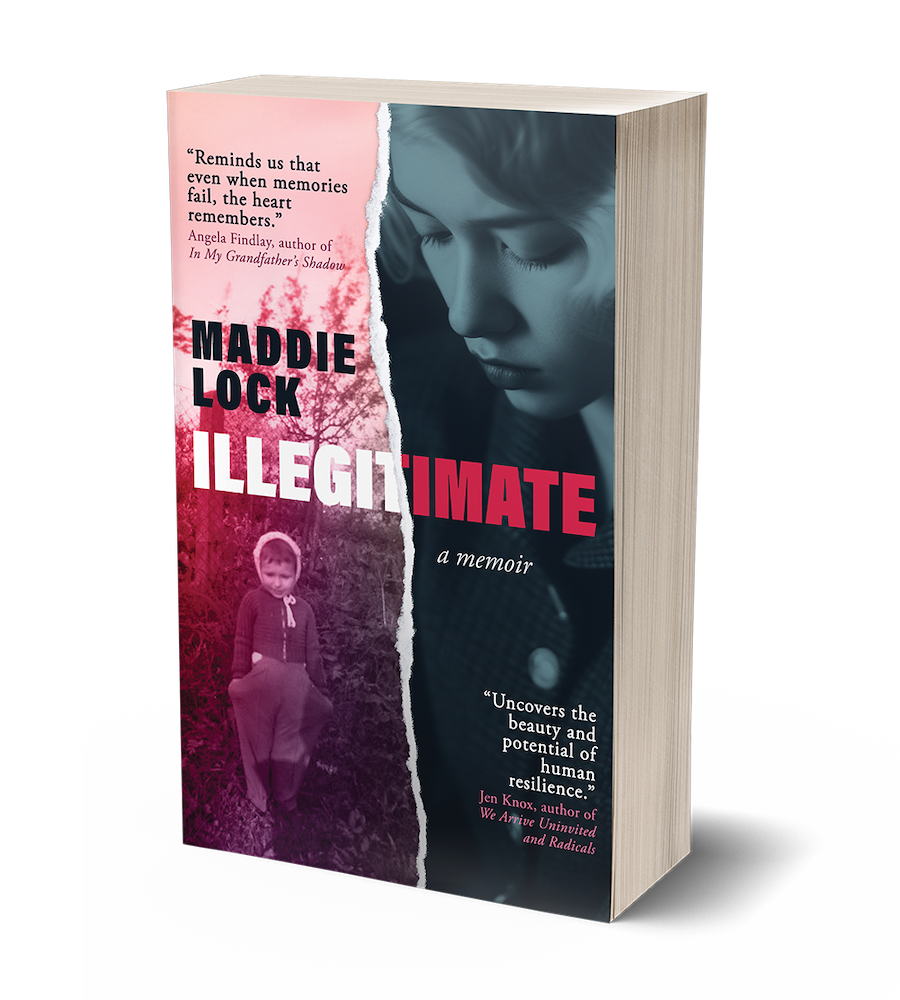
Illegitimate, Maddie Lock’s new memoir, is the true story of two women who had to uncover the identities of their fathers in order to truly understand themselves. The author reaches back into the history of World War II to tell a remarkable story of self-discovery. Here, she shares an excerpt.
Bad Nauheim
July 2017
A month to immerse myself in German life. A vacation rental with a spacious bedroom, combined living area with a small kitchen and a large Ikea kitchen table. A bathroom with a small shower; I can’t bend over to shave my legs without my ass slapping the tile behind me. Banks of turn-and-tilt windows in all three rooms for maximum light and air flow. A small stone terrace that a bushy-tailed red squirrel and two fat blue jays call home. A charming place to have a light supper of sliced red peppers, cucumber, melon, and a fresh roll slathered with quark— cheese yogurt—beside a piece of salmon.
A month to get to know my father.
A year ago, I rang his bell. When I returned for his 90th birthday bash in December, our time was filled with festivities: Weinachstmarkts gawking, gluhwein drinking, bratwurst eating, and a lot of oohing and aahing. This summer is our time to just hang out. To get to know each other in quiet times. Hopefully, there will also be time to spend with my new brother. Time to talk again. Time to find a definition for our relationship that we can both embrace.
The trip is topped off with a visit from my son, Jay. He will be joining me in a week to meet his Opa and spend time with his new extended family. Then he and I will fly the few hours to Iceland. On our trip in 2016, we stayed in Reykjavik, drove the Golden Circle, then over to the southern part to see the black sand beaches at Vik. We loved the island so much, we dreamed about going back to Akureyri in the north, where the landscape is completely different. It was after that 2016 trip with him that I went to Germany and found my father. This time, we’ll do the same trip—Iceland, Germany—but in reverse, and like I introduced myself to my father, I’ll be introducing my son to his grandfather.
My apartment is in a quiet residential neighborhood close to the forest with its many trails. I’ve rented a bicycle. It’s a five-minute downhill ride to Father’s apartment, three minutes to the town center, a minute to a narrow, paved walkway that cuts through to the numerous forest trails. If I want I can ride up to Johannisberg, the small mountain whose ridge offers an excellent restaurant and an even better view of the town, the countryside, and the castle of Friedberg nearby. I attempted the uphill climb one morning but quickly gave up. I’m a flat-Florida girl. Today a ride into the woods took me past a mini farm with two colossal pigs mired in mud. Dusty hens pecked and clucked around the ankles of a middle-aged woman with blonde hair, rugged skin, and a quick smile.
Beyond her chain link fence lies a plateau of blue-green wheat. On the gravel path through the Hochwald, dense woodland on each side is carpeted in forest detritus. A slight downhill curve leads to adjacent ponds. Each one is graced with age-old willow trees weeping out over the water, trunks laced with moss. As I stood on the narrow plank bridge between them, small waterfowl strode on the thick mat of pond leaves, occasionally dipping their black heads into the murky water. In the adjacent pond, large fish appear out of the gloom only to vanish into the shadows of the weeping willow. A placard erected in front of the pond suggested I may be looking at a muddy catfish. Charcoal clouds hovered in the distance. A hut, its wood blackened with age, contained two benches waiting for those who may need to get out of the rain.
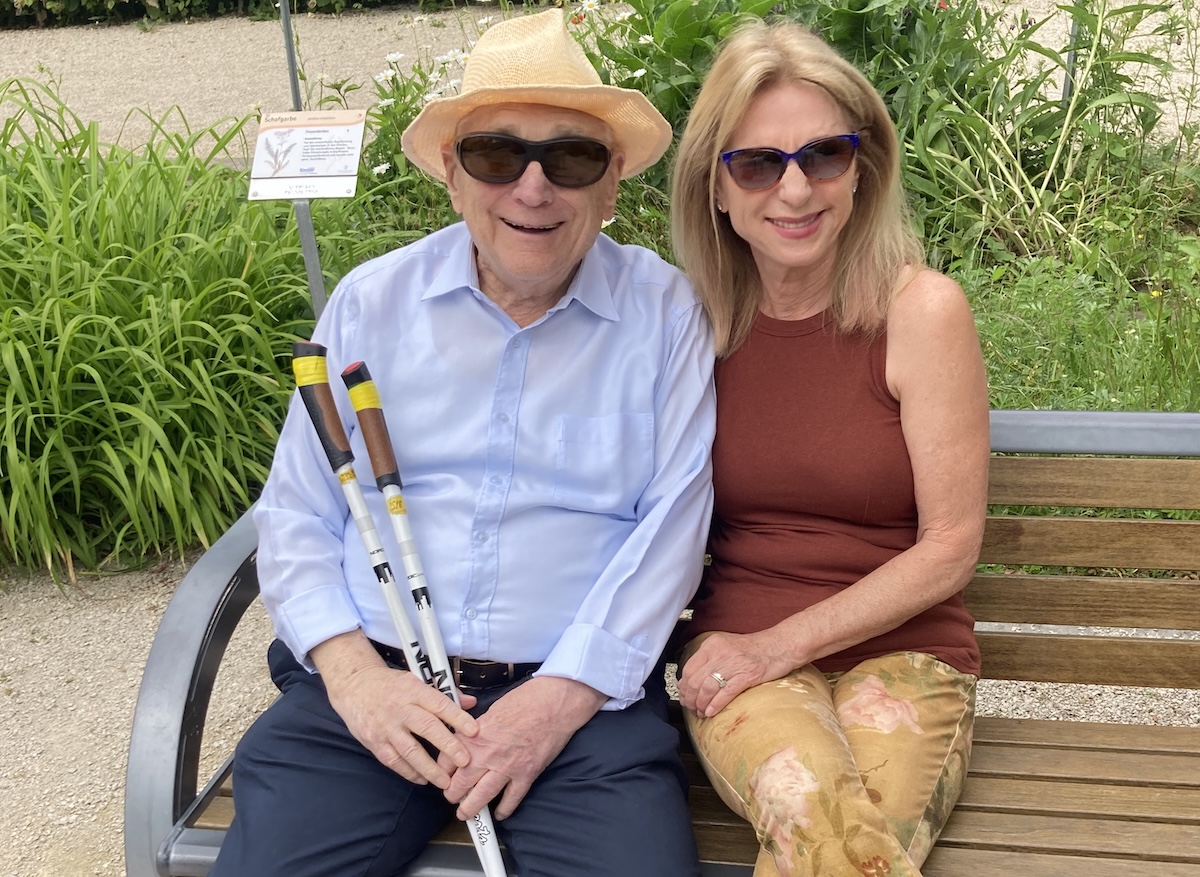
Later that afternoon, Papa, Niklas, and I were having coffee at an outdoor café called the Hexe Hutte, the Witches Hut. As we watched children splash in the small neighboring water park, thunder clapped loud and close. Some of the children screamed. A dog asleep underneath the next table bolted up, spun in circles and dove under its owners’ feet. Niklas and I also jumped. My smiling father settled deeper into his chair. Puzzled at his lack of reaction, I looked at his ears. They were empty. Papa had left his hearing aids in the small bowl by his front door. Anni was not home when we left. She’s the one who makes sure he has house keys, his wallet, hat, and sunglasses. She always tries to get him to take his walking stick, but most times he refuses. Anni keeps his life, and him, organized. He gratefully accepts this and anytime we start talking about making plans he tells me to get with her, happy to defer any large or small decision making.
Niklas and I gestured for him to finish his coffee, mimicking lifting the cup and drinking. Still sighing contentedly, he settled in even more, nodded at us and took a delicate sip. I pointed to the sky and the wind-tossed tree canopy. He looked up, and with a jolt told us we needed to hurry, come on, let’s go! Niklas looked at me and rolled his eyes. We were barely underway when the skies opened. What a sight we must have been: an old man, an, ahem, mature woman, and a burly young man dashing madly through parking lots and gardens. Home was only five minutes away, but on arrival we shook ourselves like wet dogs.
My dear Papa. He handed out towels, brought me an ironed, perfectly folded shirt of his. Hurried back into the bedroom. Now came a pair of his jogging pants, also freshly washed and pressed, (goodness, Anni must iron everything) which I declined. Niklas dried off and flounced onto the divan to turn on the television. I argued with my father about not messing up his perfectly ironed clothes. After the rain stopped, I hoofed it back to my flat and changed to return in time for Abendbrot, the traditional German evening meal of bread and cold cuts.
***
Time with my father has been rich and fluid. Initially in awe around him, I’m now comfortable and enjoy small moments in his company. We’ve talked more about his relationship with Mom, although on this subject he remains a man of few words. I can tell he is reluctant, and careful, with what he says.
Ach, we were young. We wanted to have fun and took long rides on my motorcycle. We rode to Montabaur and I met her mother. We rode to Switzerland to see her sister Gunda, and then to Sulzbach to visit the Gross Ur-Eltern.. But things didn’t work out, as you know. It was a time I put away, no need to dwell on things that can’t be changed. I hope you understand.
I do.
He told me he’s glad we’re able to spend time together. I told him, me too.
There are challenges, of course. My command of German still isn’t where I wish it to be. The grammar continues to be a bafflement to my Americanized brain. He has challenges, too. Often tells me I can’t see, I can’t hear, his hands waving around his head like angry bees. Even with hearing aids in, gestures and loud repetitions are often necessary. But his energy is remarkable. I tend to forget his advanced age.
Our conversations are long and boisterous, words and phrases and gestures tossed about. Papa will find a marvelous word and pick it apart in English, German and French, understanding all its meanings and the nuances that may or may not be used interchangeably. He loves the sound of words, as do I. After learning the printing trade, my father began a long career in Germany’s federal printing department responsible for anything official such as banknotes, passports, and driver’s licenses. He beams whenever we discuss books and my writing. His crowded shelves include German versions of some of my favorite books, including Gone with the Wind and Rebecca.
After the evening meal around 7:00, we often sit and chat as the insistent summer sun takes its slow leave. Tonight I mentioned Kant’s “das ding an sich” (a thing in itself); noumenon as opposed to phenomena: the thing that exists whether we recognize it or not. Thing. Ding. Chose. He went through his litany and then looked at me sternly: do you understand? It’s impossible to fib, even when confession of not understanding will launch him into telling me the same thing in several different ways. For a man who claims to not see well, he is able to look intensely in my eyes to look for truth.
I reminded him I don’t speak French. He sighed, as if he were speaking to a child who had not done her lessons.
“Chose. It means a thing.”
We switched to history. How everyone, even children, drank ale in the Middle Ages as an alternative to dirty water. We discussed an Arquebus—the first long gun—and the disadvantages of needing a tripod to hold it, which in turn led to the more mobile musket. I pulled up photos of the Tower in Sulzbach on my phone and pointed to the remaining unaltered arrow slits.
“Here you go. The bow and arrow came first. Then the poor guard had to figure out how to balance and aim the Arquebus through these tiny openings. Once he could use a musket his life, and aim, was better, right?”
He nodded sagely and looked pleased, as if I had learned something after all.
Our discussions typically become a lively roundabout of hand waving, pointing, arm touching, laughing, sighing, and Google Translate (which he calls that clever machine) between the three of us. Anni often understands my translations first and tells Papa, who cups his ear, then exclaims ah and repeats to confirm understanding, nodding wisely. The time we spend around the table, this warmth and comfort and ease; well, this is something I didn’t have at home, not once, growing up.
It so feels like family.
***
Papa, Anni, and I take the train from Bad Nauheim to Frankfurt Airport. Jay is on the non-stop flight from Orlando which gets in around 11:00 a.m. I’ve reserved Luka Taxi for the return to Bad Nauheim. My stomach is roiling with nerves. Will Jay like his Opa? Will they be able to communicate well enough, since Jay doesn’t understand German? I don’t want their time together to be awkward. I’ve filled the next few days with walking activities that should take care of uncomfortable silences. My son will enjoy the blackthorn towers with their dissipating salty air and the rejuvenating Kneipp pool in the herb gardens. We have dinner planned at Tiramisu, my favorite Italian eatery close to our rental apartment.
As Jay appears at the exit with his duffel bag, my eyes well up and spill over. He looks tired and nervous. I grab him in a tight hug and hold on way too long. He shushes me and looks embarrassed. Heads toward my father with his arm outstretched for a handshake. His new Opa and Oma welcome him with big hugs and exclamations of delight, which serves for more embarrassment: here are three old people not able to control their emotions. My son hates a scene, and he looks for the door leading out to the taxis.
Luka is waiting and loads the duffel into the trunk. Anni and Walter will take the train back so Jay and I can catch up. We will get together again later in the afternoon for coffee.
***
My father has chronicled his life in photos and videos. Years of travel around the world are recorded, often in both stills and movement, then notated with a voice-over. Pages upon pages of detailed written description. As are events with friends and family. During our afternoon coffee at Müllers’ Bakery, I looked back to find him with the video recorder held up to record my pastry selection. Each visit nets me a CD of our time together. He has also Googled my name and found my website, with all my writings and media. They have been printed out and sit in a folder with my name in large letters across the front.
When Jay and I get to the apartment around 4:00, my father falls into his favorite routine: sharing his life. Often in the afternoons he will open a cabinet, and with his index finger trail the spines of the binders of DVDs he has catalogued until he finds one he wants to share with me. He’ll slip on a huge pair of magnifying goggles so he can see, headphones so he can hear, and inserts his choice into the DVD player. Then he settles in with a small smile. He looks over occasionally to make sure I’m delighted. I smile and nod. He wiggles his bottom into the chair and nods back, satisfied. Or, we get out the photo albums so I can feast my eyes on a happy, healthy mother. Today we delve into the latter, and Jay gets to experience his grandmother as a happy young girl.
Birthdays, holidays, festival days, vacations; every year has been celebrated. Hair color, body weight, eyeglasses, and clothes, chronicle the changes as time rolled by. I have gotten to know my father’s mother and sister, and their home in Frankfurt which was bombed twice during the Allied invasion. No photos of his father. He told me his parents divorced at the end of the war but did not elaborate. The final video of his sister Bertha shows her in a wheelchair on an outing in a park. She is gaunt, a far cry from the stout and smiling aunt who held me proudly for the camera when I was three. She died a few days after the recorded outing.
Papa continues to create a continuum of his existence. With camera or recorder in hand, he saves present moments for the future. He says he doesn’t believe in God: because of the war—especially at the end of the war, when we found what people had done to each other—I knew there couldn’t be a God. What matters is family. And this I know. Their small family has always been close, Oma and Opa happily involved in Niklas’ upbringing. Birthdays and holidays celebrated with various aunts and uncles. When I commented on his diligence in recording the events in his life, he nodded. “I figure one day my memory may go. If it does, I can go back and know I existed.”
Now my son will be part of those memories. The video camera began in the airport, recording our emotional greeting for posterity. My handsome manchild with the family blue eyes, cropped hair once blonde and now brown, and lush mahogany beard which Papa remarked on with a chuckle, something about the lack of razors in America and the Taliban. Today, he is treated to pictures of me as a child. I’m not so sure about his comfort level. Everything German is foreign to him, and he side-eyes me a few times as if he is looking at a stranger. But he smiles politely, and eventually his shoulders ease as he feels the happiness in the room. Accepts that his mother is more than just his mother.
We meet my half-brother and his family that night for dinner. The conversation flows, and I notice Jay assessing his cousin, Niklas. They share a similarity in looks, with a strong forehead and deep-set blue eyes. Both handsome. Both strong. They both tend to watch everything and keep opinions to themselves, making it difficult to know what they are thinking.
Later that night, back at our apartment, Jay mentions the similarity in looks that he and Niklas share. We end up discussing genetics, and the traits that run through him from multiple nationalities. My husband’s paternal side is mostly English, originated from Anglo Saxons who were Germanic people from Northern Germany and Denmark. His maternal side, the Hungarians, originated from Magyars, an ethnic group from central Russia who ultimately mingled with several races creating a diversity of skin and hair color. My genetics testing shows mostly German, along with a quarter Frankish which also includes Germanic tribes.
Although we tend to look at physical features as a manifestation of genetics, so much more goes into family resemblance. My husband has dark brown hair and brown eyes; his mother was blonde and blue-eyed and his father had dark brown hair and brown eyes. Everyone in my German family had or has blue eyes, with blonde or brown hair; I have greenish-blue eyes and so does Jay. As a child, he looked like the perfect “Aryan” specimen, with light blonde hair and those blue eyes, but as he grew into adulthood his hair darkened.
I think about the children who were taken from their families in other countries to be “Germanized” because they met the physical criteria of what was considered desirable and superior. What would have happened to my son once his hair changed color?
***
Papa calls himself a pessimist, but I disagree. So does Anni. When he adamantly makes statements about the sorry state of people, the country, the world, she looks up at the ceiling and shakes her head, a smile playing at the corners of her mouth. In the next sentence, he will extoll virtues of the very subject he just maligned. An understanding of the yin and yang inherent in all things. I would call him a pragmatist at worst, a realist at best. He’s also gregarious. During our frequent outings, he loves to hobnob with folks nearby, which often leads to introductions and a promise to see each other again soon. He always introduces me as meine Tochter aus America. This never fails to get a raised eyebrow, and a curious eye turned on me.
There are moments in our conversations when his face clouds. If I ask a question about the war. Or sometimes about my childhood. There are memories and feelings he doesn’t wish to share with me. Yet. Time may change that. Or perhaps these are things I don’t need to know.
One day we were sitting over lunch, and I asked him how many times he was able to arrange a visit with me when I was a child. We had been talking about the video in which I showed off with the red scooter and the hula hoop. I was laughing at my frenetic need for attention, which was so obvious. He stared off for a moment, then looked down. His smile faded. I saw resignation and anger in his face. Not often, he answered. Then he changed the subject.
He must have been devastated to be denied contact with his child. As a mother, I would find it impossible. At some time, at some point in my life, I heard that his family wanted to take me in, but my angry mother would not have it. I can’t remember where or how I heard this. Or maybe it was wishful thinking.
For now, I must be satisfied with the time we spend in laughter and discovery. And self-discovery. What I have come to realize is the enormity of reference: of knowing who I am by knowing who my father is. A relief. To have only had my mother as a reference and allowing that reference to be tainted by all the shortcomings I heaped on her, created a sense of incompleteness. We need our parents to reflect from, at least when we are children. Sure, sometime in our early adolescence many of us decide we desperately need to be different than those odd and boring creatures we live with. But if we’re lucky, a secure foundation has been laid that we can balance on. Not all of us get to feel that sense of security.
Throughout youth and into middle age—and even now if I let it—uncertainty has prevailed. The Thesaurus offers alternatives: anxiety, ambiguity, ambivalence, confusion, mistrust, skepticism, suspicion, disquiet, indecision, puzzlement, bewilderment. Can I admit that all those synonyms were mine to juggle at any given time? Yes. And the most defining? Lack of confidence. Whenever I tried to figure out why I felt uncertain, the answer that came to mind was that I was misplaced.
No amount of accomplishment, no amount of attention, no number of reassurances could quell the incessant restlessness I felt. I was that child who sits in the front row in school, frantically waving her hand when she knows an answer: pick me, pick me. Pick me so I can prove that I’m worthwhile. Important decisions I had to make created agony: was it the best one? It wasn’t okay to be okay. I wanted so badly to excel. I wanted to turn the differences I felt into something extraordinary, because I never felt that I could be ordinary and be okay.
Until I saw the frenetic video of myself, I thought my uncertainty came from being plucked out of my native country and thrown into one so foreign that I was unable to adapt properly. I needed something and someone to blame, so I fixated on the severing of my German umbilical cord. Set adrift, I tapped first one foot and then the other, unable to find solid purchase. I blamed my mother because she made those choices for me.
But since spending time with Papa, I believe the uncertainty is rooted in early childhood. When I think I have disappointed someone I care deeply for, let them down in some way, my heart seizes before it gallops crazily. Synapses in my brain flash and ignite. I can’t breathe. The guilt is sometimes overwhelming. Should I assume this was ingrained in that child who thought only of herself, callously unresponsive to her grandmother’s wishes to stay out of trouble and harm? A desire for control over my life lies at the heart of it all.
Mom told me a story about one of my shenanigans, as was told to her by Oma. This makes the veracity iffy at best since the facts have been rearranged in multiple memories multiple times. But as I listened to it, images and smells flooded in, along with my thoughts.
The child is lounging on the kitchen divan, an afternoon “nap” time— during which naps rarely occurred— when she sits up. Quietly makes her way out of the apartment door, down two flights of freshly waxed mahogany stairs, out the front door, down the sidewalk, across Kantstrasse, and somehow makes her way to the four-lane highway on which cars zip past on the exit road into the town of Montabaur. The police officer who brings her home explains to her shocked Oma that she was found in the middle of the highway, arms flailing first in one direction, then another. Very much as if she were attempting to direct traffic.
My intentions are unclear as I recall my route to the highway. But the streets I crossed, the asparagus growing along the highway and the sound of the cars zipping by are there. Perhaps I wasn’t “in the middle of the highway” perhaps I was off to the side, in the midst of the wild asparagus. If I were to venture a guess as to motivation, it’s possible that my almost constant uncertainty translated into an immense need for action, for a sense of control. Was this prompted by the father who came and went, a mother who appeared and disappeared? Or by the grandmother who, after raising six children of her own, was handed a responsibility she hadn’t asked for?
My mother raised me with criticism. I realize now that she may not have known another way to show her concern. The way her life was as a child, with her mother’s need to rely on her at much too tender an age, may have rendered her incapable of giving loving support. Her attempts to guide me translated into do not do this or that bad thing will happen. It is my mother’s life, her fears, that she passed on to me. The stress on Oma to work and provide for six children must have been tremendous. My mother carried the brunt of day-to-day household chores and care for her siblings. One of her greatest fears must have been to fall short of what was expected of her. There was also the specter of legal ramifications. Rules were a way of life, and a breach could bring about a heavy knock on the door, a lack of rations, or worse.
One clear memory stands out. I was sixteen and hung out with a group, mostly boys, in the first neighborhood we moved to in Florida after Ted retired from the Army. We skipped school occasionally, got high on pot, and caused neighborhood mayhem now and then. One night we found an unoccupied house with a pool and decided to go skinny-dipping. When we finished, we threw all the patio furniture into the pool. As we made our way out, bright lights and three police cars waited for us. Fortunately we were taken home, our parents informed that next time they would have to come to the police station to bail us out. I was put on restriction. My stepfather was livid. When Mom looked at me I saw fear in her eyes. She said something like: Please stay out of trouble until you’re eighteen. Then you won’t be my responsibility anymore.
I can’t help but wonder about the person I would be had my life been guided by the strong confidence of the father I am coming to know. He is a man of character and high morals. Also loving and understanding. I can only guess at what he was like as a younger man. Perhaps I’m romanticizing. But now, finally, in the encroaching golden years of life, there is hope and a true possibility of belonging. Of fitting my odd-shaped sockets into the proper slots to complete the puzzle picture. With no shadow of insecurity lurking about.
One thing I was certain of when my son was born: he will be raised in a home of security and love, with every opportunity to be the person he is meant to be. I never want him to feel as if a part of him is missing or dismissed, like I did. The days we spend with Papa and Anni, brother Michael and his family, slide by with ease and enjoyment. As I look back on this trip, I know it became a beautiful and secure bow of the knot that ties us together as family.
You can preorder the book from Vine Leaves Press. You can also preorder an ePub from Amazon, where you’ll later be able to preorder a print version.
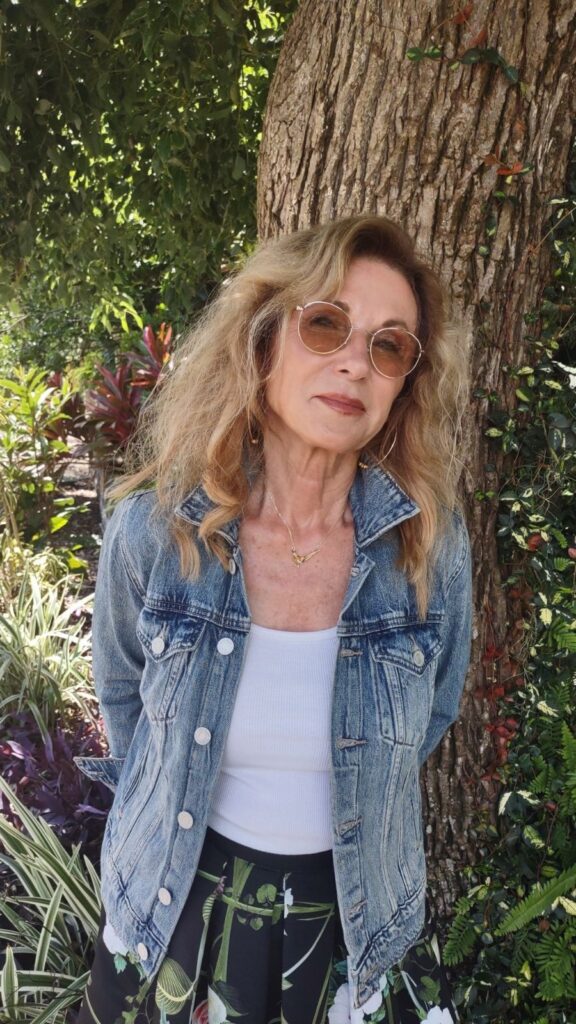
German-born and adopted by an American Army officer, Maddie Lock graduated with a BA in English Lit from the University of South Florida. She began a freelance journalism career before sidetracking into the corporate business world. After founding and selling a successful multi-million dollar enterprise, she returned to her first love of writing. Maddie is the author of two children’s books, including the RPLA award-winning Ethel the Backyard Dog. Her essays have been published in various journals and anthologies, including the Unleash Conversations anthology in which her essay “The Stranger” won Editor’s Pick. On a trip to her homeland in 2013, Maddie discovered a long-held family secret with tentacles reaching back to Hitler, which began a journey of research, revelation, and redemption. Find out more at www.maddielock.com.